The Woman with the Pot

Amondi Awuor
Contributor
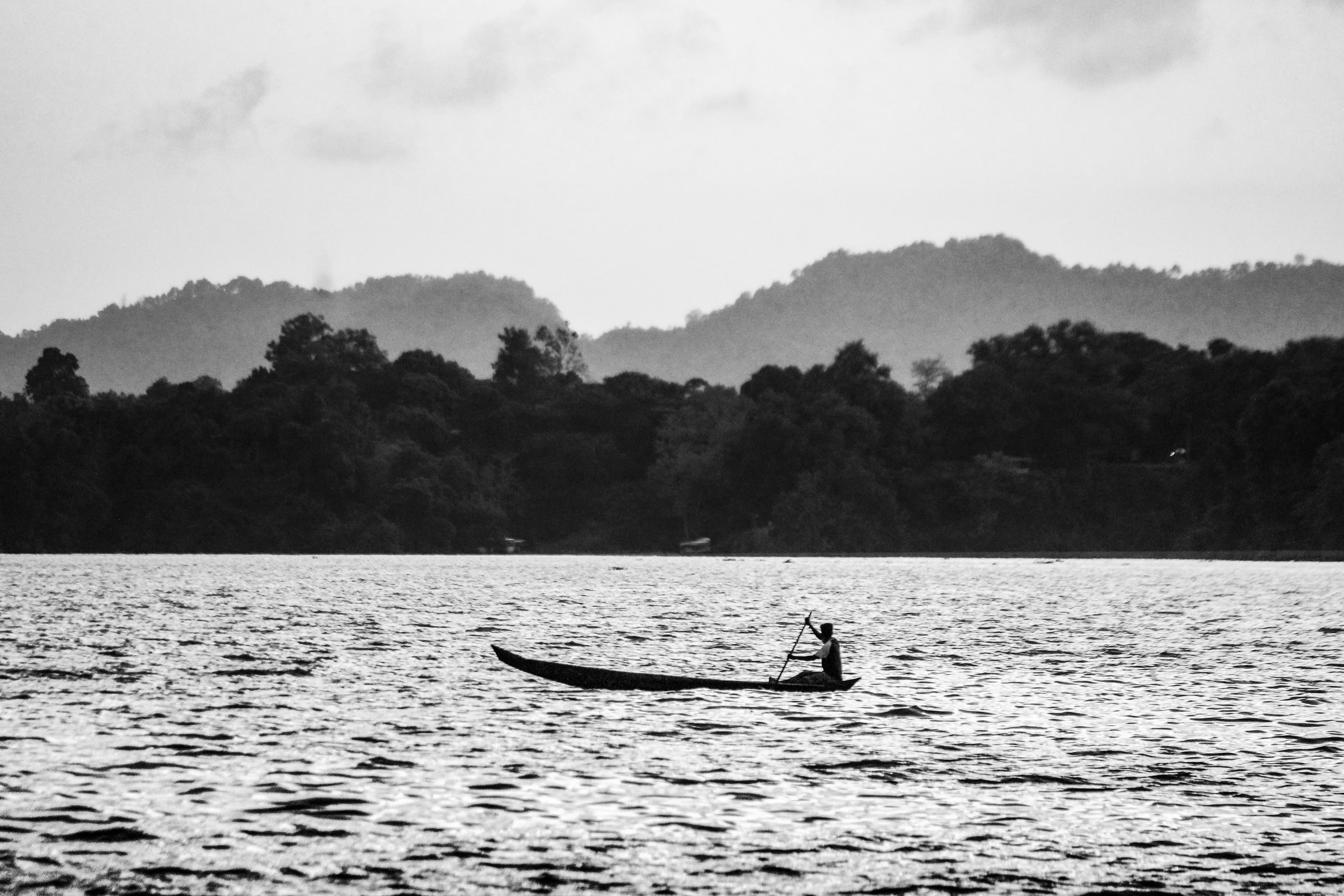
Image by Sayeed Chowdhury
-
My husband demands peace, but he denies me any of it unless I agree to Budho dho Nam- the lakeside vigil. This is the only way to guide him out of the water otherwise, his spirit will become nyawawa. I am tired. I don't have the strength. I keep waiting for his steady voice, his calm presence. But he returns to me only in dreams and the restless pull of the lake. I accepted his strength as my rock but he turned me into the crying stone and forgot to tell me that I was also expected to anchor his ghost. I, alone, stand between him and polo, our paradise.
The night mirrors the chaos raging inside my breasts; waves prowl the shorelines like a hungry lion arguing with the rocks on Dunga beach: this is a bad omen.
I am not to look; it is taboo. So, I stand amidst papyrus marshes some distance off the shore, water slithering around my ankles, braving the merciless cold like Luanda Magere fighting off the Nandi. But I wonder if he was also five months pregnant and stripped naked to face Lake Victoria at midnight.
I can feel stones biting back at the soles of my feet like spirits testing my resolve, as if I am the one assaulting them. Behind me, a crowd whispers and I can feel Oburu, his brother, staring greedily at me.
The old, withered hands of Dani Rapondi guides my right leg up, steadying trembling limbs in their wake. I shift from one foot to another, hypnotized like a moth to a flame, mesmerised by the black waters before me.
I’ve never believed the stories my mother used to tell me about her people. After all, these were her traditions, not mine; but the ritual is working. My soul reaches outward. But to what?
“Not yet.”
The withered voice croaks from somewhere in my subconscious, halting my concentration, blocking whatever manhunt my soul had commenced. My heart pulses painfully—a trapped drum, wild and urgent.
“Breathe, Akinyi, daughter of the lake...”
Her voice penetrates the fog in my mind. Air shoots out of my chest. Her ancient hands, strong and precise, glide from the sole of my foot to the shin of my right leg. The shoreline mud climbs up my leg following her hands. With each desperate inhale, a connection is forged between my soul and Budho dho Nam.
“Nyasacha…” I whisper.
I feel him now; his spirit. A strong, confident master of the waters. Fishing was his second nature and he died doing what he loved. His presence now squeezes the breath from my lungs. His form carried the zeal of a man honoured by the lake and recognized by the ancestors. Others might have failed, but his hands always had a way of luring the omena into his trap. He never failed. “The omena is a sign my hands will never run empty,” his voice tells me.
My feet obey the rhythm of the ritual and begin moving.
But, where to?
Again, the chill in Dani Rapondi's voice shackles my feet to the ground.
“You are not ready yet,” she says. “If you go now, you might not come back.”
I stand still yet again, my breath intertwining with the pull of the ritual. The mud eagerly embraces my feet as I sink further and further. The grisly woman begins a chant, circling me like a vulture that has spotted a snake. Her first cold humming stirs a chorus of other voices from the crowd behind us.
The sound rises from the depths of her chest, vibrating through the air like something buried beneath the earth trying to wake up. The villagers follow her humming, injecting sobs in between the sounds.
Another voice answers from somewhere behind me. Then another. Then another.
The hums gather slowly, folding over each other in haunting rhythm until the night itself seems to breathe along.
I see myself leave my body and join the lake.
I see him now. The lake welcomed him at dawn with its shades of purple. By day, the sun kept him company with its hypnotic hues of blue and gold cast over the waters. He was connected to the lake; its waters were a second family. The currents were his home.
I see his hands intertwined with mine, his silhouette in front of me. He steers the canoe through the morning haze, navigating the thick mats of water hyacinth, a plague that had long ago settled on the surface of the lake and become a menace choking the fish and omena that were often so close to his heart.
But the water hyacinth became a blessing too, a constant companion whose spread had met our ingenuity and been turned into fuel to keep us warm. Maybe our ancestors weren't punishing us after all.
The small caked hands move to my thighs, still coating my skin with a new layer of mud but it seems that as I am, I am still not enough for the spirits to use. Her humming grows louder, and the choruses too have risen somewhere in the dark but inside my head the voices are silent, too silent, enough to hear him, “You will be mine…”
The wind carries his voice to my ears, heavy and threatening, as though even the air itself is cautious.
‘Oluoch… you cannot let your brother marry me,’ I beg, but no words leave my mouth.
This is a sentence already passed, closing in on me from all sides. My chest tightens as I understand what has been decided over my body: the tradition of a man waiting for his inheritance.
I should run. I should have run. I should be running.
But my feet do not listen and I realise that I no longer own my body.
I see Oluoch and me far from the shore, surrounded by the waters on all sides. For the first time, I see his true intentions. My eyes look everywhere except at him as I shy away from his gaze. I can feel the all-too-familiar tingling sensation washing over me.
I remember this day. Somehow, he couldn’t let me wander away from his sight. After every few moments, he would stop paddling just to look at me, as though he feared the lake might steal me if he looked away too long. Then without warning, he reached across the canoe and wrapped one of his beaded bracelets around my wrist.
“So the waters know you belong with me,” he said softly.
I remember the way the breeze carried his words across the lake, the way my heart stumbled against my ribs.
I see the spot where I accepted the stubborn man, his fisherman spirit and his fleeting soul that always wandered into the farthest parts of the lake. I witness how we forged our union with the sky, the water, and the wind cheering us on.
I should have held onto that moment and never allowed it to end. I should have…
I suck in a deep breath as I am pulled out of my vision. I stare in confusion until I feel her cold hands moving across my thighs. The coldness and finality of death follow her hands. She settles on my womb and hesitates. I wince as pain blooms low in my back and a sharp ache pulls at my spine and hips. I have been standing for far too long.
She smooths the mud over my child with a gentle swipe, startling me.
I see his eyes soften, his hands holding me upright, his ears listening to my belly as if the unborn child would speak back to him. He begins drawing small circles over my womb. In his eyes, I see a reflection of his unspoken oath: he will protect us.
My daughter, I know she is a girl. Oluoch always wanted a girl, said the world was too mean for a boy. His daughter will never know her father. She will never know the wonderful man who is part of her.
The headache comes keening; I don’t want my daughter to inherit this, to have intrusive fingers mark her body before she even knows her name.
As if sensing my fear, my child kicks and my hand instinctively flies to my stomach.
“Stop!” Dani Rapondi's voice commands.
My hand falls to my side in a tight fist.
Her hands continue their unhurried torture on my bared breasts. The humming begins a faster, urgent, louder rhythm. My hands are the last to receive the mud. They are numb from the tips of my nails to the hollow of my neck. Chants rise to a crescendo, filling the night: the ritual is about to reach its climax. With her forefinger, she traces the shape of my heart before sealing it with mud.
I let go.
I feel him now. I hear him. If I just reach out, if I just try hard enough, I can touch him, I can love him, I can save him. But I can’t.
It began with the rainfall and with it came sicknesses: malaria, cholera, dysentery moving from house to house taking its weakest hosts.
Oluoch remained unaffected; the waters were his family. The waters knew him. We were safe, the waters protected us, my child and I until now.
My hands creep lower to pick up the pot beside me. I lift it slowly, my eyes never leaving the lake. Dani Rapondi pours clean water into the pot.
“This will give you a clear vision,” she whispers.
On their own, my legs move to the lonesome stone he loved. I see him, he has a grass straw between his lips, a straw hat atop his head that shields him from the dying sun as he looks across the still lake, thoughts drifting somewhere farther into the water. He always sat here at the end of the day, listening to the silence between the waves.
He doesn't hear my footsteps as I creep towards him. He hates being tickled, but I do it anyway.
His straw hat tumbles from his head as he lunges after me, laughter bursting from his chest, deep, throaty, and alive. My feet betray me in the sand and I topple onto the shore laughing breathlessly. His face hovers above mine, glowing gold beneath the sinking sun.
I see his smile, then his kisses which arrive one after another on my forehead, my left cheek, my right cheek, my chin, my nose, my eyelids, and finally my lips. “I want to memorise every part of you…” he says.
I love him.
I walk alone, shutting my eyes to the vision and the ache in my chest. No one is supposed to accompany me; we must not confuse him. So they stand in the safe haven of the trees looking for any sign of him.
I place the tach atop his favourite stone and sit on it, the pot on my lap. The glare of the moon focuses on the pot.
He couldn’t escape the waters that day. The rains had stopped, and the sun was smiling again at us. The lake called to him, and he could not have ignored such an invitation.
He set out on his canoe with a promise of an omena feast accompanying him when he came back. I watched as he faded into the open expanse of the lake. Two hours later, I watched again as clouds gathered above the same waters and the first trickle of rain pour. I watched the light showers turn into a turbulent storm, the afternoon sky turn into the greyish hue of evening and heard the clap of thunder shatter the horizon.
Two days later, he was still nowhere to be found. I knew I had lost a part of my soul. He was lost to the lake.
Oluoch is stubborn; he gives me a hard time, calling out his name in the dead of night.
I am supposed to call his name to the pot, and so I do.
“Oluoch, awacho nyingi e pi — dwoka.”
He was alone that day. The waves toppled his canoe. The black hole swallowed him up and refused to let him go.
“Oluoch… Aluongi… wuog e pi… ariti…”
The water sank into his mouth. His hands rose in frantic supplication breaking the surface; wailing, pleading, begging for a mercy that didn’t arrive.
I can't reach him, no matter how much my soul thrashes against the distance between us. The water folds over him slowly.
The tears come gushing out of me. Screams echo into the silent night. The waters took my beloved away from me. It is time they let him go.
“Oluoch…winja…winjdwolna…nyaka idwogna…”
I don’t recall how long I stay in this position, crying into the pot, calling out for him.
But just before dawn, as the air hums with a peaceful stillness that settles over the lake and the gathering behind me, the thin veil of mist floating above the water moves slowly like a tired night spirit retiring for the day, I see it. At first, I mistake it for driftwood—a swollen log surrendering itself to the tide. Then it shifts. Nearer now. And I hold my breath.
The water carries the burden of him slowly toward the shore. Oluoch drifts towards me. I stay still. The part of my soul that used to light up in his presence is suddenly snuffed out, leaving a cold, hollow ache where his love used to be. His overstuffed body rolls with the waves, heavy but obedient to the current.
“Jowi!”
I feel his brother’s steely gaze.
“Jowi!”
The villagers walk towards the shore to raise the body from the waters.
“Jowi!”
I watch as the sun kisses the horizon.
“Ero, peace at last.”
GLOSSARY
Akinyi- a luo name for a girl born in the morning.
Budho dho Nam — translates to the “lakeside vigil”; when a husband drowns in the lake and his body isn’t recovered, according to luo tradition, his wife sits on the shoreline to call out his name until his body is recovered.
Dani — Grandmother
Rapondi— a luo name for a girl born at daybreak
Ero — an affirmation meaning “yes,” “indeed,” or “finally”; expresses satisfaction when something turns out as desired.
“Jowi!” — Buffalo! (mourners cry out the name jowi! when someone who was influential, strong or powerful has died. )
Luanda Magere — a great luo warrior; it is said he had godlike strength and fought against the Nandi to protect the luo people
Nyasacha — my God
Nyawawa — marine spirits
Oburu — a luo name for a boy born during a funeral
Oluoch — a luo name for a boy born on a cloudy day.
“Oluoch, awacho nyingi e pi — dwoka.” — “Oluoch, I speak your name into the lake — answer me.”
“Oluoch… Aluongi… wuog e pi… ariti…” — “Oluoch, I call your name… come out of the water. I am waiting for you. ”
“Oluoch… winja… winj dwolna… nyaka idwogna…”- “Oluoch, listen to me, you have to come back to me….”
Polo — heaven, paradise
Tach — a sisal head pad;ring-like cushion made from sisal, and used to balance water pots on the head
Written by
Amondi Awuor
Phelister Amondi Awuor works with data; turning complex data into simple information that can be easily understood using, poetry and storytelling. She uses her poetry and storytelling skills to advocate for issues affecting women and girls. She is interested on how gender, mental health and climate change issues affect women and girls in grassroot areas. When she is not performing, you will find her reading and writing short informative blogs and articles.
View all storiesJoin the Conversation
(0 comments)Sign in to join the conversation
Share your thoughts and engage with our community